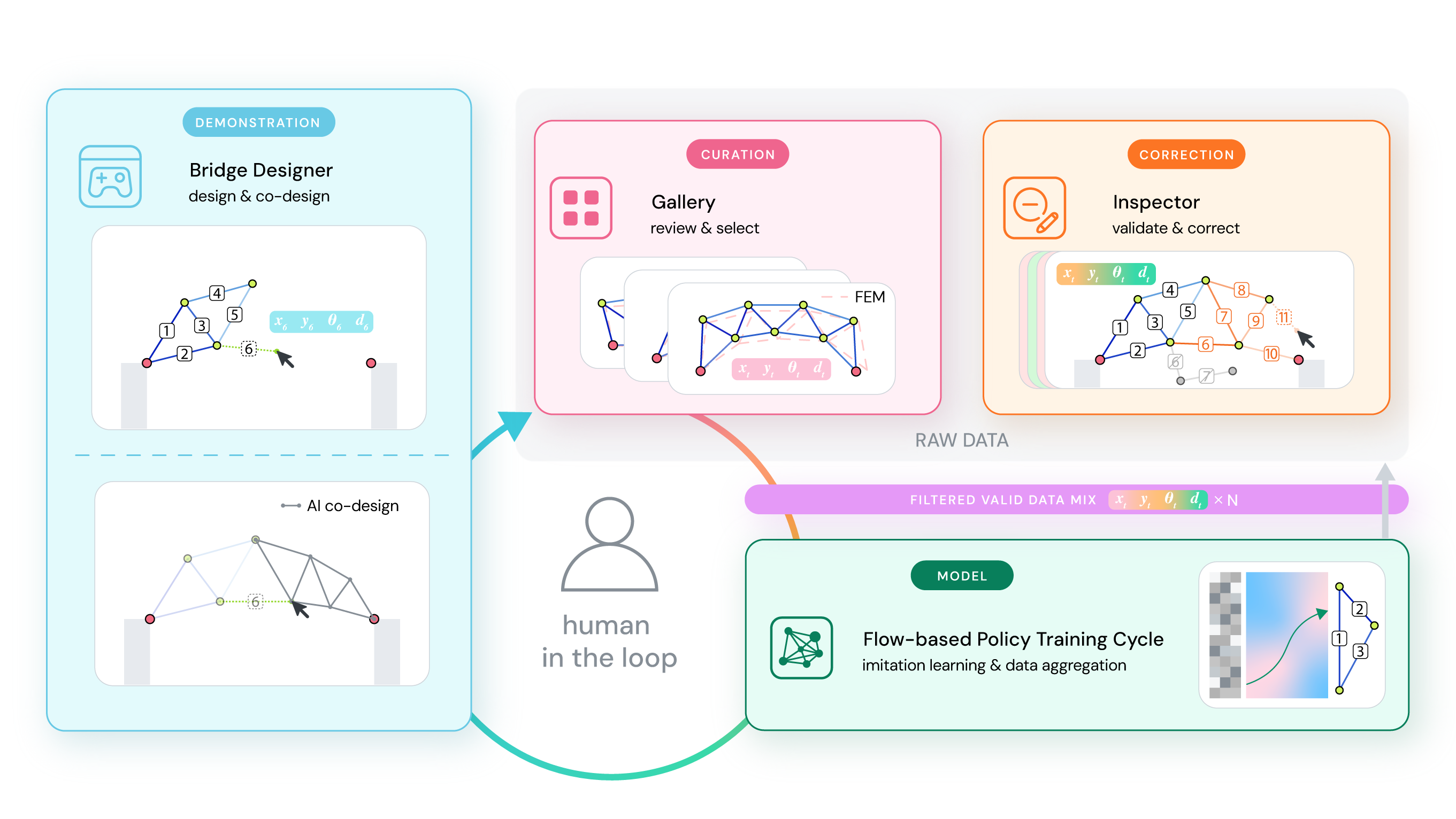
Capturing structural design intuition for human-AI co-design.

Good structural design depends on judgment that is hard to write down: how a designer reads a design brief, conceptualizes a scheme, and knows when a structure feels right. We present a human-AI co-design framework that keeps the designer in the loop throughout training and deployment. The model learns implicit design knowledge directly from human demonstrations and collaborates with the designer through iterative back-and-forth on a shared artifact.

#StructuralDesign · #ImitationLearning · #FlowMatching · #HumanAICoDesign · #GenerativeDesign · #HCI

See how it works

The problem

Some design knowledge lives in the doing.

Engineers do more than calculate. They read load paths, sense proportion, weigh constructability, and make small commitments before every criterion can be formalized. Most computational tools ask them to define the design space first. This project asks whether AI can learn from the way designers actually move through it.

Environment

Sequential design, grounded by physics.

We developed GooGym2D, an open-source 2D structural design testbed based on the Gymnasium API. It frames truss design as graph construction in continuous space. Each action chooses an anchor, heading, and length; hindsight adjustment preserves the intended final geometry; and terminal finite-element analysis checks connectivity, mechanisms, yielding, and buckling.

Design action formulation
Hindsight nodal adjustment
FEM validation

Framework

One loop, from teaching to teaming.

The pieces form a single human-in-the-loop cycle. Designers demonstrate and curate examples; a flow-based policy trains on them; a designer replays and corrects where it fails; and the improved policy returns to the browser as a co-design partner.

Demonstration

Designers show the AI how they design.

Each bridge begins as a sequence of human decisions in the browser. Across 323 seed demonstrations for 3 spans, the dataset captures different ways of solving the same structural problem: deep trusses, flatter profiles, symmetric moves, and stranger but still valid geometries.

BridgeDesigner

Curation

Keep the examples worth learning from.

A dataset is also a design decision.

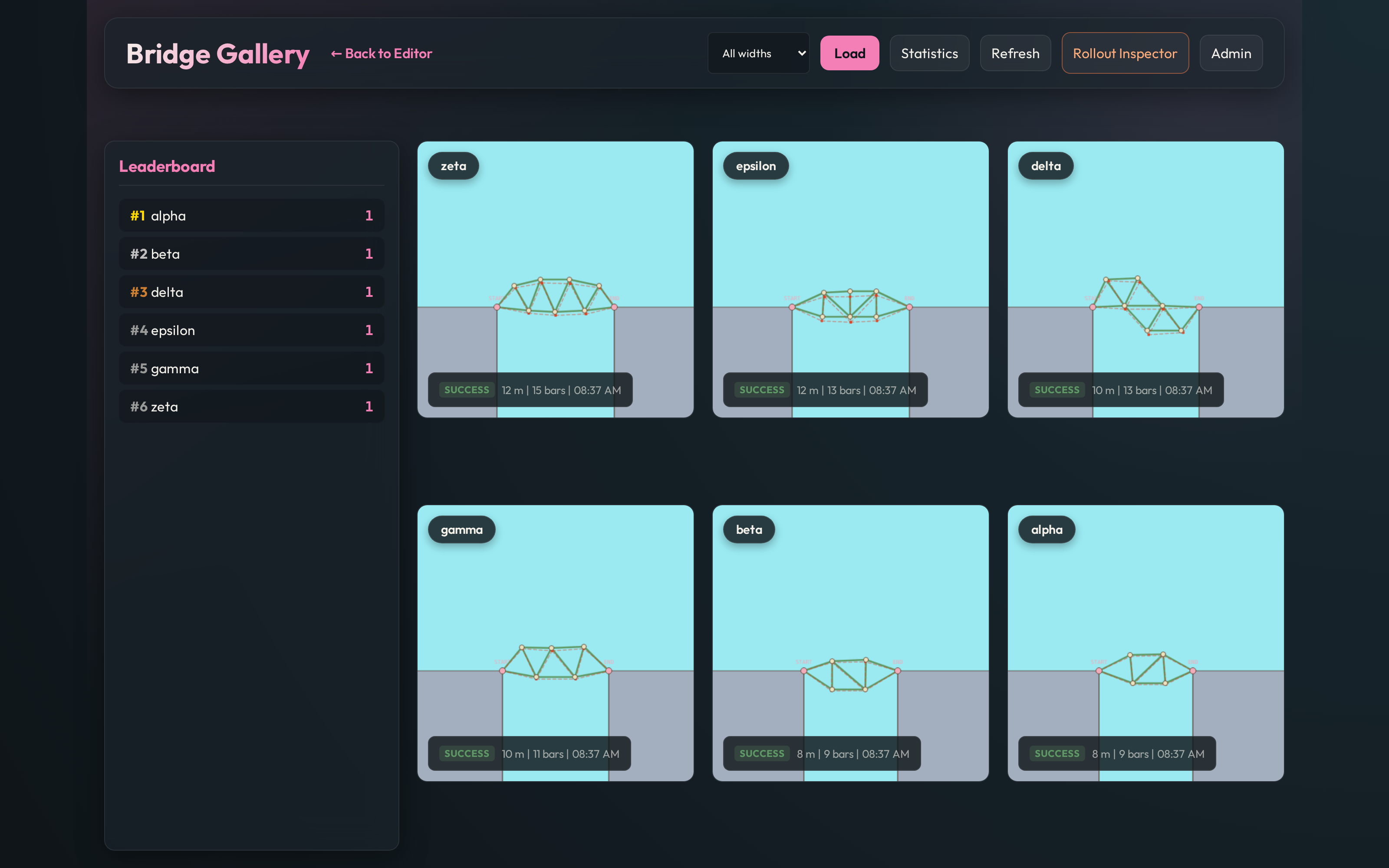
The gallery lets successful bridges be replayed, compared, and curated before they enter training, so the model learns from work a designer is willing to stand behind.

Bridge Gallery
ACADIA web-player gallery of successful bridges

Training

Flow matching turns noise into actions.

For any design, there is never one correct answer.

Flow matching provides a way to represent this multi-modality and lets the policy learn a distribution of plausible design actions, so the same start can lead to different structurally sensible options instead of one averaged compromise.

Each query predicts several bars together (action chunks), helping the model express short design intentions rather than reacting one placement at a time.

Correction

Replay the rollout, fix what failed.

The AI acts first; the human intervenes only when needed.

The inspector replays the rollout, finds the moment worth saving, and takes over from there. That correction becomes new training data aimed exactly at the model's blind spot.

Human-AI Co-design

Design together, turn by turn.

After training, the policy comes back into the Bridge Designer, forming a mixed-initiative system. The human places a bar, the AI offers ghost-bar continuations, and the designer keeps the final say: accept a suggestion, ignore it, or keep drawing by hand.

Results · Training

Targeted correction makes the policy better.

The model improves because the human does not add random examples. Each round corrects the states the policy actually visits and struggles with. The selected policy reaches 36.5% width-balanced success across the three trained spans.

0% width-balanced success

Results · Generalization

Trained on three spans.

The policy learned from bridges at 8 m, 10 m, and 12 m.

Project Information

Papers, code & contact.

The IASS paper focuses on capturing structural intuition through flow-based imitation and human-gated correction. The ACADIA paper extends the same infrastructure into a browser-based teaching-to-teaming co-design framework. Both papers are built on GooGym2D, an open-source, graph-based structural design environment with FEM validation.

IASS 2026

Capturing Structural Intuition: Human-Gated Imitation Learning for Structural Design with Flow Matching

Tao Sun, Shaoyi Wang, Simon Schleicher, Ramon E. Weber

Proceedings of the IASS Annual Symposium 2026 · PDF coming soon.

@inproceedings{sun2026capturing,
  title     = {Capturing Structural Intuition: Human-Gated Imitation
               Learning for Structural Design with Flow Matching},
  author    = {Sun, Tao and Wang, Shaoyi and Schleicher, Simon
               and Weber, Ramon E.},
  booktitle = {Proceedings of the IASS Annual Symposium},
  year      = {2026},
  organization = {International Association for Shell and Spatial Structures}
}
ACADIA 2026

From Teaching to Teaming: Human-AI Co-Design Environment for Architectural and Structural Design

Tao Sun, Shaoyi Wang, Simon Schleicher, Ramon E. Weber

Proceedings of ACADIA 2026 · PDF coming soon.

@inproceedings{sun2026teaming,
  title     = {From Teaching to Teaming: Human-AI Co-Design Environment
               for Architectural and Structural Design},
  author    = {Sun, Tao and Wang, Shaoyi and Schleicher, Simon
               and Weber, Ramon E.},
  booktitle = {Proceedings of the Association for Computer Aided Design
               in Architecture (ACADIA)},
  year      = {2026}
}